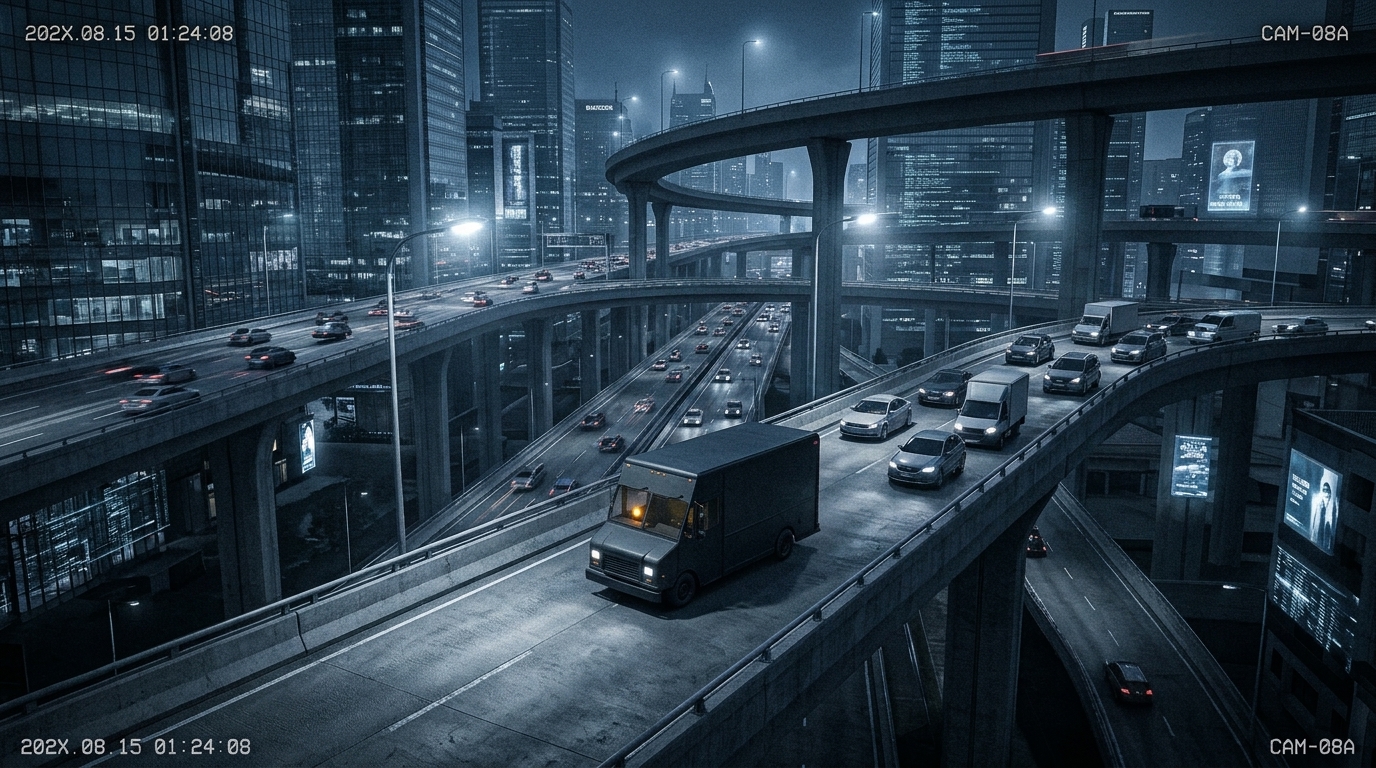
The van was facing the wrong way.
It stood nose-first on an exit ramp, its front wheels turned towards the traffic that should have been coming down it. From the height of the camera the interchange looked like a diagram someone had recently tidied. A blue car passed beneath a flyover. Water flashed between two office buildings. Beside the van, a man bent to lift something from the open side door.
Piers paused the recording before I could see what it was.
“Transport exception,” he said.
We were in a room called Willow, although the only growing thing in it was a patch of damp under the coffee machine. Helen had taken the chair nearest the door. She was typing on her tablet with both thumbs, and had arranged her expression to show she was still attending to us.
“Is that the arrival I asked about?”
“That's the transport exception associated with the arrival.”
“Associated how?”
Piers turned his laptop far enough for me to see the ticket number. He didn't restart the film. I could see the man's hand beneath a pale elbow now, the care with which he was supporting it. What I had taken for luggage was a person.
“The operations team have reviewed it,” he said.
“I need the departure event. If we received somebody here, there should be a record of where they left.”
“Unless they're an exception.”
On my fourth day at the Aster Institute, I was still trying to discover which questions were naive and which were unwelcome. It was a well-paid distinction. They had hired me for twelve weeks to reconcile two reporting systems ahead of a launch whose date appeared on almost every wall. Clinical arrivals went into one system, research activity into another. The resulting dashboard showed people arriving repeatedly, leaving without arriving, or being in two places on the same afternoon. I had made a living from worse.
An ordinary transfer left a pair: the sending team's departure record and the receiving team's arrival. Match the person and the journey, and you could close the query. This arrival had nothing to match it to.
“I'm not asking anyone to investigate the accident again,” I said. “I need to know which field says it's an exception.”
Helen looked up. “Was it an accident?”
Piers clicked away from the video.
“An incident. We don't need to decide what to call it. Sam, does the missing field prevent you completing the mapping?”
There was a version of the answer in which I said yes and we spent the rest of the morning finding the person who knew. There was another in which I used the category they had given me and finished the work. My invoice for the first week was open on the second screen of my own laptop. I had checked the number twice before sending it.
“I can handle an exception,” I said. “I need someone to own the definition.”
Helen put down her tablet. “Research operations. Anything with a reference disposition can be excluded from the clinical departure check. It doesn't belong in that count.”
“Excluded, or resolved?”
“Resolved for your purposes.”
Piers smiled with relief. It was a pleasant smile. He had spent part of my first morning explaining which vending machine returned your money and which one required a form. I liked him in the minor, useful way you can like a person who has made an unfamiliar building easier.
He closed the ticket.
The little window said THANK YOU FOR HELPING US IMPROVE.
* * *
At my desk, I wrote the rule as Helen had described it and left it disabled.
That was my habit with exceptions. Put them somewhere you could look at them before they became normal. The arrival carried the identifier TX-8841. Its source field was blank, its destination was Clinical Left, and its final status was a green rectangle that said COMPLETE. I copied the identifier into the working notebook I used for things that did not fit neatly into a ticket.
Piers came past carrying a large cardboard box against his chest.
“You all right for stationery?”
“Are those pens?”
“Continuity launch mugs. We ordered before the slogan changed.”
He put one on my desk. YOUR FUTURE IS IN SAFE HANDS, it said, above a drawing of two hands that did not look particularly safe. One had six fingers if you counted the thumb.
“Can I sell this after the launch?”
“Not until the embargo lifts.”
He moved on, distributing obsolete confidence.
My desk faced a window overlooking the staff courtyard. A gardener was on his knees prising something out from between the paving stones. Every so often he straightened his back and stayed still, looking at nothing. Beyond him were the glass doors to the clinical wing. Staff crossed between the buildings carrying lunches, folders, a bunch of flowers wrapped in brown paper. If there was anything remarkable about the place, it was how little effort it seemed to make to appear remarkable.
I ran the disabled rule against a copy of the morning's data.
The discrepancy count dropped from seventy-three to nineteen.
That was too good. Whenever a change solved most of a problem on the first attempt, I assumed I had removed the problem's ability to report itself. I picked five excluded records and followed them back. Three had clean references to research orders. One had a destination marked legacy, which was unhelpful but common. The last was TX-8841.
I opened a chat to Helen.
Can you confirm reference disposition means no clinical departure event expected?
She replied four minutes later.
Correct for reconciliation scope.
I asked whether we should preserve an unresolved flag in the research view.
Owned by research operations.
I looked at that answer for a while. It was precise about the thing she intended to say. I pasted it into the change note and added that the rule did not establish what had happened to the person. Then I enabled it on the test report.
Piers sent back a thumbs-up and an invitation to a deployment meeting.
At eleven, I walked down to find the person who owned the research view. Her name was Imani Cole. She occupied a desk behind a door labelled RELIABILITY, where a repair had left a rectangle of brighter paint around the handle. A dismantled desk fan stood on her windowsill.
“Piers said you'd be able to help.”
“Piers believes help is a naturally occurring resource.”
She made room for my laptop by moving a bowl containing screws. Her hair was twisted up with a pencil, and she took it down to write my ticket number on a piece of paper. The pencil was shorter than I expected.
I showed her the rule.
“It's consistent with the interface contract,” she said.
“Good.”
“I didn't say it was good.”
I waited. She scrolled back to the raw record, then checked which credentials I had used.
“This field tells you who's counting something. It doesn't tell you whether the something should be counted.”
“Helen says research operations handles the exceptions.”
“Then leave a link to their queue. Otherwise the report will look as if someone has dealt with them.”
I added the link while she watched. The title changed from Unmatched Arrivals to Clinical Unmatched Arrivals. It was a small, defensible improvement.
“Do you own that queue?” I asked.
“I keep it available. Different job.”
“Can you tell me who does?”
She gave me a name I didn't recognise and the address of a shared mailbox. When I asked about the van, she shook her head.
“I don't do transport.”
I thanked her. At the door I turned back.
“What's wrong with the fan?”
“It's louder when it's off.”
I must have looked blank, because she smiled and tapped the metal grille.
“It rattles against the window when they run the extraction downstairs. Facilities says fans aren't part of the building. I'm collecting evidence.”
That was the first conversation we had. We spent more time on the fan than on the people my new rule had removed from a count.
* * *
The deployment meeting was held standing up, although there were chairs around the edge of the room and everyone wanted one. A man from finance shifted his weight between his feet while Piers described our progress. I explained the exception, the narrowed label and the link to the other queue. Helen confirmed the classification. Nobody objected.
I asked for the confirmation in the change record.
“Already there,” Helen said.
It was. My name was beneath hers. R17, a modest revision in a modest system, with a rollback procedure, a timestamp and a paragraph of qualifications that would be collapsed by default when anyone read it.
“We should retain the raw feed,” I said.
The man from finance looked up as if I had offered him a chair.
“Does that affect storage?”
“Very slightly.”
“How slightly?”
I gave him a number. He sat down to write it, and the rest of us followed his example.
Before we signed, the testing analyst asked me to show her one of the records that would disappear from the count. Her name was Beth. She had a packet of biscuits open beside the keyboard and offered one round without looking away from the screen.
I selected a research order with a complete source reference. It passed through the new rule exactly as I expected.
“And one with the source missing?” she asked.
I brought up the van's record.
The status changed from unmatched to research-only. The raw fields stayed where they were, and the clinical total went down by one. Beth wrote both outcomes on her checklist.
“Which page does the person dealing with it use?”
“The research queue,” Helen said.
Beth followed my new link. A permissions notice appeared. She looked up.
“That's expected,” Helen said. “It's a separate team.”
Beth marked the functional test complete, then added a note that she hadn't tested the destination. I watched her do it.
She closed the checklist and pushed the biscuits towards me. I took one. Nobody in that room had agreed that an unresolved arrival should be forgotten. We had agreed on a working link to a place none of us had opened.
The rule went live at four. Nineteen unresolved clinical arrivals remained. Someone put the new number in a launch update, without the word clinical. I corrected it in a reply. Piers thanked me privately for spotting that.
In the last hour, the shared mailbox sent an automatic response to my question about TX-8841. It provided a reference number and said the matter would be assessed according to priority. Below that was a line advising me not to include personal clinical information in follow-up correspondence.
I had included an event identifier, which was the whole reason event identifiers existed.
Outside, rain had darkened the courtyard. The gardener was gone. Two nurses came through the glass doors, one holding her jacket over both their heads. They ran as far as the overhang, laughing at something I couldn't hear, and stopped to shake themselves off before coming into the office wing.
My phone offered a photograph from a year earlier. Mum on a hospital bed, glaring at me because I had taken it without asking. Her hair was just starting to grow back. She wore a blue cardigan with one cuff pulled down over the cannula. I had saved the photograph because it was the first one in which she looked annoyed rather than frightened.
I dismissed it before anyone could see.
Piers paused by my desk on his way out. He had put his coat on inside out and was deciding whether it was worth correcting before he reached the lift.
“Good day's work,” he said.
“There's still that transport record.”
“There will always be a transport record.”
He said it kindly, as practical advice from someone who had been there longer.
“Don't be here all night,” he added.
I wasn't. I shut down my laptop, put the launch mug in the sink and went to find my jacket.
At the door I remembered that I had left my notebook on the desk. I came back for it. Beneath TX-8841 I had written a question during the meeting and then crossed it out to make room for Helen's answer.
Where did they come from?
The words were still readable. I closed the notebook and took it with me.